Light Pollution
For most of human history, the night sky was simply part of life — a clock, a calendar, a compass, and a source of story. According to the 2016 World Atlas of Artificial Night Sky Brightness, more than one-third of humanity can no longer see the Milky Way from where they live — including 60% of Europeans and nearly 80% of North Americans. The atlas found that more than 99% of the U.S. and European populations live under light-polluted skies, and that almost half of U.S. land area experiences light-polluted nights.[9] The cause is artificial light at night (ALAN): light that spills upward and outward, brightening the sky rather than illuminating the ground.
This is not just a concern for stargazers. Artificial light at night affects human health, disrupts ecosystems, wastes energy, erodes cultural heritage, and may alter local and regional carbon cycles.[8],[10] It is a form of environmental pollution — one that is widespread, largely unregulated, and still growing.
For most people alive today, it no longer is.
Even a bright phone or computer screen can slow your eyes' adjustment to the dark, costing you 20–30 minutes of night-vision sensitivity. This page uses a warm dark-background color scheme to help reduce that impact during or before a night observing session.
Light pollution takes four distinct forms, each with different causes and effects:
- Skyglow — the diffuse brightening of the night sky over populated areas, caused by light scattering off air, dust, and water vapor
- Glare — excessive brightness from a source that causes visual discomfort, or makes it harder to see the surrounding area
- Light trespass — light that falls where it is not intended or wanted, such as a streetlight shining into a bedroom window
- Clutter — confusing groupings of bright sources that create visual noise and can contribute to accidents
A 2023 citizen-science study published in Science found that the brightness of the night sky — as experienced by human observers — has been increasing by roughly 7–10% per year. That rate of growth implies a doubling time somewhere in the range of 8–10 years, though the exact figure depends on local conditions and how it is measured.[18] These increases are not fully captured by older satellite measurements, in part because spectral shifts and emission-angle changes in modern LED lighting are not well represented by the sensors on currently operating satellites.[2] A 2024 review in Nature Reviews Earth & Environment concluded that existing monitoring techniques lack the spectral and spatial resolution needed to track light pollution trends throughout the night, and that improved satellite capabilities are needed.[31] Globally, lighting (indoor and outdoor combined) accounts for roughly 20% of electricity consumption and 6% of CO₂ emissions,[31] with a substantial fraction of outdoor lighting directed uselessly into the sky.
A Shared Sky, Disappearing
The night sky has been a shared reference point for human life across many cultures and throughout recorded history. People have looked upward and found meaning in what they saw — navigating oceans, marking the seasons, and weaving the stars into their foundational stories. That connection is now at risk, not from any single event, but from the slow, cumulative brightening of the sky over generations.[13] Each topic below can be expanded for more detail.
Indigenous Astronomical Knowledge
Many Indigenous cultures maintain living astronomical traditions — oral histories, navigation systems, seasonal calendars, and ceremonial practices tied directly to specific stars and the structure of the Milky Way. As skyglow spreads, these traditions become harder to practice and teach in place. A 2020 study examined how the disappearance of dark skies threatens thousands of years of cultural knowledge tied to direct observation — knowledge that cannot be fully preserved in books or digital archives because it depends on being able to look up.[13] For these communities, light pollution represents the erosion of a functional, living knowledge system maintained across generations.
Mythology and Narrative Across Cultures
Greek mythology, Chinese astronomy, Polynesian navigation, Aboriginal Australian sky maps, Norse cosmology, and Mesoamerican calendrical systems — throughout recorded history and across many cultures, the night sky has provided a framework for understanding time, place, and identity. These are not merely historical records. A generation that grows up unable to see the sky firsthand loses direct access to that framework; the stories survive, but their grounding in direct observation does not.
Art, Literature, and Human Imagination
Van Gogh's The Starry Night, Homer's descriptions of a star-lit sea, the navigational feats of Polynesian wayfinders, the astronomical poetry of Omar Khayyam — the night sky has shaped human artistic and intellectual imagination across many cultures and centuries. When children grow up never seeing the Milky Way, that inheritance becomes abstract rather than experiential. Photographs and planetariums can evoke it, but they cannot fully substitute for the real thing.
Access, Equity, and the Right to Darkness
Access to a natural night sky is increasingly discussed as an environmental right, particularly for rural and Indigenous communities whose land is affected by light trespass from distant urban areas. Researchers and policy advocates argue that the loss of darkness has equity dimensions — it often falls most heavily on communities with less influence over lighting decisions in their surroundings. This perspective has gained traction in international policy discussions, including the Convention on Migratory Species' 2024 light pollution guidelines,[7] and in growing legislative activity at the municipal and national level.
Light Pollution Maps
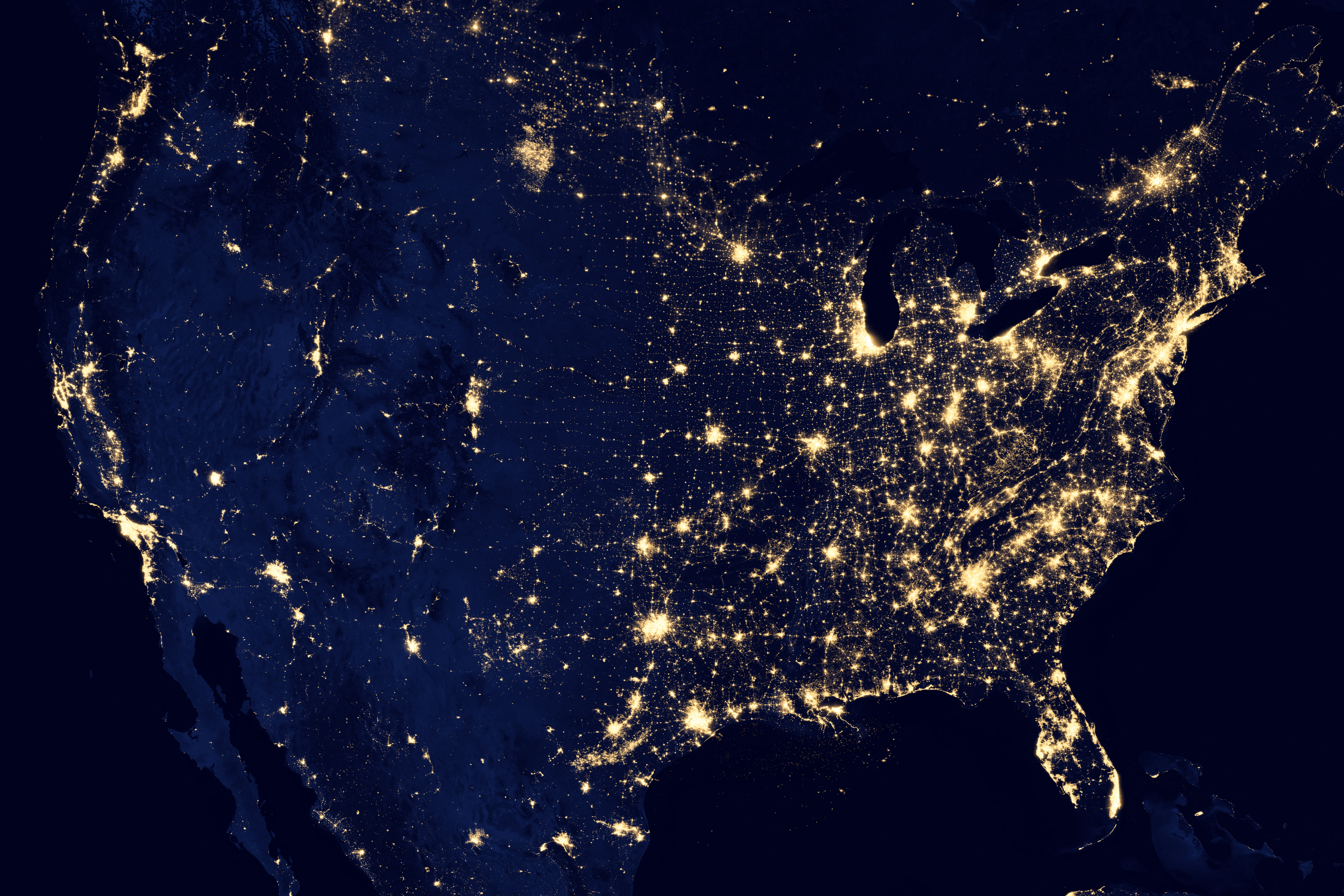
Image by Robert Simmon. U.S. Government work — public domain.

Used for educational purposes under fair use.
The NASA image shows upward light emissions from the ground, whereas the Falchi atlas represents sky brightness as experienced by an observer on the ground. This distinction matters: skyglow depends not only on how much light is emitted, but also on its direction, its spectrum, and how it scatters in the atmosphere. As a result, the affected area extends far beyond city limits. Across much of the Eastern United States, artificial sky brightness is high enough that truly dark skies are no longer accessible.[9]
Find the light pollution at your location
Common Misconceptions
Several widely-held beliefs about outdoor lighting are not well supported by research — or are true only in specific, limited circumstances. Click any item to see the evidence.
Brighter lighting improves safety
NOT ALWAYS
The idea that more light means better visibility is incomplete. Seeing well at night depends on contrast, even distribution, and controlling glare — not just the total amount of light. Fixtures that are too bright or poorly shielded produce glare, which actually reduces contrast and can make it harder to see objects away from the light source. A large controlled study across England and Wales found no significant increase in road accidents when street lighting was reduced.[24] Well-designed, properly aimed lighting can improve safety, but simply adding more light does not guarantee that outcome.[26]
- Steinbach, R. et al. (2015). Journal of Epidemiology & Community Health, 69(11). — Reduced street lighting had no significant effect on road accidents (UK).
- Lighting in ATM Environments. NCJRS, U.S. Dept. of Justice (1997). — Evidence inconclusive on whether increased lighting improves safety.
Blue light at night is only a problem from screens
FALSE
Blue-light concerns are often framed as a phone, tablet, or laptop issue — hence the popularity of "night mode" settings and blue-blocking glasses. But for most people, outdoor lighting is a much larger source of environmental blue light than screens. A single 4000 K LED streetlight can contain roughly 30% of its output in the blue portion of the spectrum, and it illuminates the area around it continuously through the night — far longer than a typical evening of screen use.[34] That light enters bedrooms through windows, scatters in the atmosphere as skyglow, and reaches the eye indirectly from pavement, walls, and other reflective surfaces.
This matters biologically because short-wavelength (blue) light, near roughly 480 nm, is the most effective wavelength for suppressing melatonin and shifting circadian rhythms. The American Medical Association's 2016 policy statement on community lighting (Policy H-135.927) was motivated specifically by outdoor LED streetlights, not by personal screens, and recommends that outdoor installations use 3000 K or lower color temperatures and be properly shielded.[34] Adoption has been uneven: some cities have converted to 2700–3000 K warm-white or amber LEDs, while others installed 4000 K or cooler fixtures during the LED conversion wave of the 2010s.
Screen-side mitigations (night mode, warmer display profiles, reduced evening use) are reasonable for individual sleep, but they do nothing to reduce the outdoor blue-light exposure that drives skyglow and affects both humans and wildlife at the community scale. Addressing the larger problem requires changes to the fixtures themselves — spectrum, shielding, brightness, and timing.[27]
- AMA Council on Science and Public Health (2016). Report 2-A-16: Human and Environmental Effects of Light Emitting Diode (LED) Community Lighting. — AMA Policy H-135.927: recommends ≤3000 K, shielding, and dimming for outdoor LED installations.
- Bará, S. (2023). Light pollution is skyrocketing. Science, 379. — Blue-rich LEDs scatter more strongly in the atmosphere and are undercounted by current satellites.
Nighttime lighting prevents crime
NOT ALWAYS
The relationship between outdoor lighting and crime is real but complicated. A 2022 systematic review of 21 studies spanning nearly 50 years found that improved street lighting was associated with a roughly 14% reduction in total crime in treated areas, with stronger effects for property crime (such as burglary and theft) and no significant effect on violent crime.[11] Other studies have found little or no benefit, and in some cases a positive association between brighter lighting and crime.[1],[5],[20] A large UK study found that reducing street light levels was associated with a decrease in crime, not an increase.[24] Overall, the effect of lighting on crime is real in some contexts — particularly for property crime — but it is not consistent, and it is not a substitute for other environmental and social factors.[6]
- Welsh, B.C. et al. (2022). The Impact and Policy Relevance of Street Lighting for Crime Prevention: A Systematic Review. Campbell Collaboration / CrimRxiv. — 21 studies, ~50 years: 14% crime reduction, significant for property crime; no significant effect on violent crime.
- Steinbach, R. et al. (2015). Journal of Epidemiology & Community Health, 69(11). — Reducing street lighting was associated with decreased crime in some areas (UK).
- Chicago Alley Lighting Project (2000). City of Chicago / DarkSky International. — Brightly lit alleyways correlated with increased crime in some areas.
Light pollution only affects astronomers
FALSE
The effects of artificial light at night extend well beyond the observatory. Light is one of the primary biological signals that governs the body's internal clock — the circadian rhythm — which regulates sleep, hormone production, metabolism, and immune function in virtually all living organisms.[4] Disrupting the natural dark-light cycle can impair sleep and health in humans, disorient migratory birds and sea turtle hatchlings,[3] shift the timing of insect emergence (which affects pollination and food webs), and alter plant bud-break schedules.[12],[14],[15] A 2021 meta-analysis of over 100 studies found that ALAN consistently disrupted hormone levels, altered reproductive behavior, and shifted activity patterns across a wide range of taxa — with effects detectable at light levels as low as diffuse skyglow.[28]
Insects are among the most severely affected groups. Artificial lights kill large numbers of insects through fatal attraction, disorientation, and exhaustion — a largely invisible toll with downstream consequences for pollination, food webs, and the many bird and bat species that depend on insect prey.[15]
A 2025 study found that artificial light at night can measurably alter ecosystem carbon exchange — increasing the rate at which ecosystems release carbon dioxide without a corresponding increase in photosynthesis.[30] (Human health effects are addressed in a separate item below.)
- Chepesiuk, R. (2009). Missing the Dark. Environmental Health Perspectives, 117(1). — Links ALAN to sleep disorders, depression, obesity, and cancer risk.
- Sanders, D. et al. (2021). A meta-analysis of biological impacts of artificial light at night. Nature Ecology & Evolution, 5, 74–81. — Meta-analysis of 100+ studies: consistent hormonal, behavioral, and reproductive effects across taxa.
- Hirt, M.R. et al. (2023). Light pollution in complex ecological systems. Phil. Trans. R. Soc. B, 378. — Cascading ecological effects across food webs and whole ecosystems.
- Johnston, A.S.A., Kim, J., & Harris, J.A. (2025). Widespread influence of ALAN on ecosystem metabolism. Nature Climate Change, 15, 1371–1377. — 86-site study: ALAN increases ecosystem respiration and disrupts carbon exchange.
Health effects of light at night only affect shift workers
FALSE
Shift work is the most-studied form of nighttime light exposure, and the evidence linking it to cancer risk is strong enough that the International Agency for Research on Cancer classifies night shift work involving circadian disruption as "probably carcinogenic to humans" (Group 2A), based on limited evidence in humans for cancers of the breast, prostate, colon, and rectum, together with sufficient evidence in experimental animals and strong mechanistic evidence.[35] The mechanism — disruption of the body's circadian system by light during biological night — is not unique to shift workers.
A substantial and growing literature documents health effects of artificial light at night in the general population, independent of occupational exposure. The AMA's 2012 report on light pollution found that residential nighttime lighting is associated with reduced sleep duration, dissatisfaction with sleep quality, excessive daytime sleepiness, impaired daytime functioning, and obesity.[36] Population studies link chronic nighttime light exposure — including light entering the bedroom through windows and ambient skyglow — to increased risks of metabolic disorders, cardiovascular disease, mood disorders, and certain cancers.[4],[25] A 2024 observational study in Frontiers in Neuroscience reported an association between higher outdoor nighttime light exposure and Alzheimer's disease prevalence in the United States.[29] Observational studies cannot establish causation on their own, but the combination of mechanistic evidence from circadian biology, animal models, and population-level epidemiology points in a consistent direction.
In short: the occupational evidence (shift work) is the most rigorous because exposure is well-characterized, but the underlying biology applies to anyone exposed to light during the hours their body expects darkness. That describes most people living under light-polluted skies.
- IARC Working Group (2020). Night Shift Work. IARC Monographs on the Identification of Carcinogenic Hazards to Humans, Vol. 124. — Night shift work classified Group 2A (probably carcinogenic); mechanism is circadian disruption.
- AMA Council on Science and Public Health (2012). Report 4-A-12: Light Pollution: Adverse Health Effects of Nighttime Lighting. — Residential nighttime lighting linked to reduced sleep, daytime impairment, and obesity in the general population.
- Voigt, R.M. et al. (2024). Outdoor nighttime light exposure and Alzheimer's disease. Frontiers in Neuroscience, 18. — Observational association between ALAN exposure and AD prevalence; causality not established.
Switching to LED lighting solved the problem
FALSE
The global shift to LED lighting was promoted as a way to reduce both energy use and light pollution. In practice, the opposite has often occurred. Because LEDs cost less to run, many cities and businesses responded by installing more lights, running them longer, or increasing brightness — a pattern known as the rebound effect. Early LED streetlights also defaulted to high color temperatures (5000 K and above), producing a blue-heavy light that scatters more strongly in the atmosphere than the warmer sources it replaced, and that existing satellite sensors do not fully measure.[2] Citizen-science data confirm that the naked-eye visibility of stars is still declining — even as energy use per fixture has dropped.[18]
- Bará, S. (2023). Light pollution is skyrocketing. Science, 379. — Spectral and emission-angle shifts in LEDs mean satellites undercount skyglow growth.
- Kyba, C.C.M. et al. (2023). Citizen scientists report global reductions in star visibility. Science, 379. — Sky brightness increasing ~7–10%/year despite LED efficiency gains.
Light pollution only matters in rural or remote areas
FALSE
Light pollution is often imagined as a concern for distant observatories or wilderness areas. In practice, its most direct health and ecological consequences fall on people and organisms living in and around cities. Urban residents are exposed to the highest levels of artificial light at night — through windows, during commutes, and from ambient skyglow — and face the greatest risks of sleep disruption and related health effects.[4] Urban wildlife is affected in parallel: city lights disrupt bird migration, draw insects away from feeding and breeding areas, and alter the behavior of bats, amphibians, and many other species in urban green spaces.[15] The problem is most intense in the places where most people live.
- Jägerbrand, A.K. & Spoelstra, K. (2023). Effects of anthropogenic light on species and ecosystems. Science, 380, 1125–1130. — Urban ALAN: well-documented effects on wildlife behavior, reproduction, and community structure.
- Chepesiuk, R. (2009). Missing the Dark. Environmental Health Perspectives, 117(1). — Urban populations carry the greatest direct health burden from ALAN exposure.
More light at night means better productivity
NOT ALWAYS
Bright environments can support visual tasks in the short term, but exposure to bright, blue-heavy light after dark suppresses melatonin production — the hormone that signals the body to prepare for sleep. This affects not just sleep quality but also immune function, metabolism, and mood over time.[25] In population studies, chronic high nighttime light exposure is associated with increased risks of metabolic disorders, cardiovascular disease, and certain cancers.[4] More recently, observational research has reported an association between chronic ALAN exposure and elevated rates of neurodegenerative diseases including Alzheimer's, adding cognitive health to the growing list of concerns.[29] The American Medical Association recommends that outdoor lighting use warmer color temperatures (3000 K or below) and minimize unnecessary nighttime brightness to reduce these health risks — a recommendation motivated by the same circadian biology that drives concerns about chronic nighttime light exposure in shift workers.[34] Productivity that comes at the cost of chronic sleep disruption is not a clear benefit.
- Stevens, R.G. et al. (2013). Breast cancer and circadian disruption. CA: A Cancer Journal for Clinicians / AMA Council Report. — Links ALAN to cancer, obesity, diabetes, mood disorders, and reproductive problems.
- Chepesiuk, R. (2009). Missing the Dark. Environmental Health Perspectives, 117(1). — Overview of health consequences of nighttime light exposure.
Closing your curtains fixes the problem
FALSE
Closing curtains or blinds at night can help block light trespass into a bedroom and may improve personal sleep quality — that is a reasonable step for individual health. But it does nothing to address light pollution itself. The problem is not indoor light: it is outdoor light directed upward and outward into the atmosphere, creating skyglow that affects a broad area.[9] Curtains do not reduce the amount of light being emitted into the sky, do not help wildlife or ecosystems, and do not improve sky visibility for anyone. Effective solutions require changes to the light sources themselves — their shielding, brightness, spectrum, and operating hours.[27]
- DarkSky International. Five Principles for Responsible Outdoor Lighting. — Solutions target outdoor fixtures: shielding, spectrum, brightness, timing, and aiming.
Light pollution is an indoor problem
FALSE
Light pollution is defined as the misdirected or excessive use of outdoor artificial light — light that escapes into the sky and the surrounding environment rather than serving its intended purpose on the ground.[9] Indoor lighting contributes to it only to the extent that it leaks out through windows, and that contribution is small compared to poorly shielded outdoor fixtures, commercial signage, sports lighting, and street lamps. A 2024 review found that street lights and outdoor infrastructure are the dominant sources of light pollution globally, with non-urban areas accounting for more than half of all satellite-observed nighttime light.[31] Addressing indoor lighting habits has essentially no measurable effect on skyglow, sky visibility, or the ecological and health impacts documented in the research literature. The source of the problem is outdoors, and that is where solutions must be applied.
- Linares Arroyo, H. et al. (2024). Monitoring, trends and impacts of light pollution. Nature Reviews Earth & Environment, 5, 417–430. — Outdoor sources dominate: street lights, infrastructure, and commercial lighting are the primary contributors to skyglow.
Light pollution only comes from the ground
FALSE
A rapidly growing source of light pollution comes not from the ground but from orbit. Satellite megaconstellations — Starlink, Amazon Kuiper, OneWeb, and others — are deploying tens of thousands of satellites in low Earth orbit. These satellites reflect sunlight, appearing as bright streaks or points of light that contaminate astronomical images and are increasingly visible to the naked eye, especially during twilight hours.
A 2025 study published in Nature projected that if planned constellations are fully deployed, about 40% of Hubble Space Telescope images will be contaminated by satellite trails, and future space-based telescopes will have more than 96% of their exposures affected.[32] Contrary to early claims that this was only a ground-based problem, satellite trails affect space telescopes as well.
For amateur astronomers and citizen scientists — including students conducting visual observing or astrophotography — satellite trails are an increasingly common disruption. The International Astronomical Union established a Centre for the Protection of the Dark and Quiet Sky (CPS) specifically to address this issue, and the AAS COMPASSE committee actively works on mitigation strategies.
- Borlaff, A.S., Marcum, P. & Howell, S. (2025). Satellite megaconstellations will threaten space-based astronomy. Nature. — Projections: about 40% of HST images and 96%+ of future space telescope exposures contaminated.
- Bará, S. et al. (2023). The increasing effects of light pollution on professional and amateur astronomy. Science, 380. — Comprehensive overview of how ALAN and satellite constellations threaten observational astronomy.
What Actually Reduces Light Pollution
Light pollution is not an unavoidable side effect of modern life. Its causes are well understood, and so are the solutions — technical, behavioral, and regulatory.[21] The core principle, articulated by DarkSky International,[27] is straightforward: use light only where it is needed, when it is needed, in the amount needed, and with the right spectrum. Everything else is waste — and that waste has real costs.
DarkSky International estimates that at least 30% of outdoor lighting in the United States is wasted — mostly from unshielded fixtures — at a cost of roughly $3.3 billion per year and the release of approximately 21 million tons of CO₂ annually.
Shielding and Fixture Design
One of the most impactful changes available is switching to fully shielded, or "full cutoff," fixtures. These direct all light downward, preventing any emission above the horizontal plane — no light goes into the sky, and none spills sideways onto neighboring properties.
Unshielded globe- or acorn-style fixtures — common in residential and decorative applications — send a large fraction of their light upward and sideways, where it contributes directly to skyglow and light trespass without illuminating anything useful.
DarkSky International's DarkSky Approved program certifies fixtures that meet standards for shielding, distribution, and color temperature. Browse certified products →
Color Temperature (Spectrum)
Light color is measured in Kelvin (K). Lower values are warmer (amber, yellow-white); higher values are cooler (blue-white). The spectrum of a light source matters for three reasons:
- Scattering: Blue-rich light (above ~4000 K) scatters much more strongly in the atmosphere, dramatically increasing skyglow relative to warmer sources at the same brightness.
- Biology: Short-wavelength (blue) light is the primary driver of melatonin suppression in humans and many wildlife species. Warmer sources cause less biological disruption at equivalent brightness levels.
- Satellites: Current monitoring satellites undercount the effects of blue-shifted LED lighting, meaning the shift to cool-white LEDs has made the problem worse than it appears from space.
The American Medical Association recommends 3000 K or lower for outdoor lighting.[33] Many dark-sky-sensitive applications — near wildlife habitats, protected areas, or astronomical sites — use 2200 K or true amber sources (around 590 nm) that contain essentially no blue component.
Brightness (Intensity Control)
Much outdoor lighting is brighter than the tasks it supports actually require. Using only the light level needed for a given purpose is one of the most impactful changes available, because light pollution scales roughly with total lumens emitted — not just fixture count.
Over-bright fixtures also worsen glare: a light source that is too intense creates harsh shadows and reduces the eye's ability to adapt, potentially making an area harder to see in rather than easier.
Adaptive dimming systems can reduce output during low-activity hours (e.g., after midnight) by 50–80% with no meaningful loss of function, significantly reducing both energy use and light pollution.
Timing and Controls
A light that is off produces no pollution. Timers, motion sensors, and adaptive controls that reduce or eliminate lighting when no one is present are among the most cost-effective tools available.
Part-night lighting — running lights at full output only during peak activity hours and reducing or turning them off in the early-morning hours — has been adopted in the UK and elsewhere with no significant increase in accidents or crime, while substantially reducing skyglow and energy use.[24]
For wildlife-sensitive areas (beaches during sea turtle nesting season, migratory bird corridors, bat foraging habitat), targeted lights-out periods can dramatically reduce ecological impact at minimal cost.
Targeting and Aiming
Even a well-shielded fixture can cause light trespass if it is aimed incorrectly. Proper installation means directing the beam at the intended surface — a parking lot, a walkway, a building face — and not onto neighboring properties, into windows, or upward into the sky.
Reflective surfaces (pale pavement, white walls, standing water) can bounce significant amounts of light back upward even from a downward-aimed fixture. This is often overlooked in installation planning.
Wall-pack fixtures on commercial buildings are frequent offenders: many are mounted to produce a wide scatter rather than a focused downward beam, sending a large fraction of their output sideways and upward. Re-aiming or replacing these is often one of the most accessible improvements a building owner can make.
Policy and Ordinances
Individual fixture changes have limited effect if the surrounding environment remains brightly lit. Broad improvement requires policy: municipal outdoor lighting ordinances that specify shielding requirements, maximum color temperatures, curfews on commercial signage, and standards for new construction.
A growing number of municipalities and counties have adopted dark-sky ordinances, often with support from DarkSky International's model lighting codes. Some jurisdictions have established dark-sky preserves or certified dark-sky communities. The Convention on Migratory Species issued international guidance on outdoor lighting for migratory species in 2024.[7]
Policy is also the most effective tool for addressing the rebound effect — the tendency for energy savings from efficient fixtures to be offset by adding more or brighter lights elsewhere. Caps on total lumen output per area, rather than per-fixture efficiency standards, directly address this pattern.
References
All references cited on this page are listed below. In-text superscript numbers link to the corresponding entry. Links open in a new tab. Light pollution research spans multiple disciplines; field tags indicate the primary domain of each source.
- Atkins, S., Husain, S., & Storey, A. (1991). The influence of street lighting on crime and fear of crime. Home Office Crime Prevention Unit Paper 28, UK. [JSTOR] Criminology
- Bará, S. (2023). Light pollution is skyrocketing. Science, 379, 234–235. [DOI] Astronomy
- Brei, M., Pérez-Barahona, A., & Strobl, E. (2016). Light pollution and sea turtles in the Caribbean. Journal of Environmental Economics and Management, 77, 95–116. [ScienceDirect] Ecology
- Chepesiuk, R. (2009). Missing the Dark: Health Effects of Light Pollution. Environmental Health Perspectives, 117(1), A20–A27. [PubMed Central] Public Health
- Chicago Alley Lighting Project (2000). A Correlation between Brightly Lit Alleyways and Crime. City of Chicago / DarkSky International. [PDF] Criminology
- Clarke, R.V. (1997). Situational Crime Prevention: Successful Case Studies. Center for Problem-Oriented Policing, Arizona State University. [ASU PDF] Criminology
- Convention on the Conservation of Migratory Species of Wild Animals (CMS). (2024). CMS International Light Pollution Guidelines for Migratory Species. [CMS] PolicyEcology
- DarkSky International. (2025). Artificial Light at Night: State of the Science 2025. [DarkSky] EcologyPublic HealthPolicy
- Falchi, F., Cinzano, P., Duriscoe, D., Kyba, C.C.M., Elvidge, C.D., Baugh, K., … Furgoni, R. (2016). The new world atlas of artificial night sky brightness. Science Advances, 2(6), e1600377. [Science Advances] AstronomyEcology
- Falchi, F., & Bará, S. (2023). Artificial light at night: a global disruptor of the night-time environment. Philosophical Transactions of the Royal Society B, 378. [DOI] Ecology
- Welsh, B.C., Farrington, D.P., & Taheri, S. (2022). The Impact and Policy Relevance of Street Lighting for Crime Prevention: A Systematic Review Based on a Half-Century of Evaluation Research. Campbell Collaboration Systematic Review / CrimRxiv. [CrimRxiv] Criminology
- Ffrench-Constant, R.H. et al. (2016). Light pollution is associated with earlier tree budburst across the United Kingdom. Proceedings of the Royal Society B, 283(1833), 20160813. [Royal Society] Ecology
- Hamacher, D.W. et al. (2020). Loss of the Night: Light Pollution and Indigenous Cultural Heritage. arXiv:2001.11527. [arXiv PDF] Policy
- Hirt, M.R., Evans, D.M., Miller, C.R., & Ryser, R. (2023). Light pollution in complex ecological systems. Philosophical Transactions of the Royal Society B, 378. [DOI] Ecology
- Jägerbrand, A.K. & Spoelstra, K. (2023). Effects of anthropogenic light on species and ecosystems. Science, 380, 1125–1130. [DOI] Ecology
- Bará, S., Ges, X., Zamorano, J., Ribas, S.J., & Masana, E. (2023). The increasing effects of light pollution on professional and amateur astronomy. Science, 380(6650). [DOI] Astronomy
- Kocifaj, M., Wallner, S., & Barentine, J.C. (2023). Measuring and monitoring light pollution: Current approaches and challenges. Science, 380, 1121–1124. [DOI] Astronomy
- Kyba, C.C.M., Altıntaş, Y.Ö., Walker, C.E., & Newhouse, M. (2023). Citizen scientists report global rapid reductions in the visibility of stars from 2011 to 2022. Science, 379, 265–268. [DOI] Astronomy
- McLeish, T. (2021, September 17). Light pollution's glare threatens all kinds of wildlife. ecoRI News. [ecoRI] Ecology
- Morgan, N. (2003). Outdoor Lighting and Crime, Part 2: The Research Evidence. Australian Institute of Criminology. [Link] Criminology
- Morgan-Taylor, M. (2023). Regulating light pollution: More than just the night sky. Science, 380, 1118–1120. [DOI] Policy
- NASA Earth Observatory (2012). City Lights of the United States. Image by Robert Simmon using Suomi NPP VIIRS data. Public domain. [NASA Earth Observatory] Astronomy
- Smith, K.T., Lopez, B., Vignieri, S., & Wible, B. (2023). Losing the darkness. Science, 380(6650). [DOI] EcologyPublic Health
- Steinbach, R. et al. (2015). The effect of reduced street lighting on road casualties and crime in England and Wales. Journal of Epidemiology & Community Health, 69(11), 1118–1124. [BMJ] Public HealthCriminology
- Stevens, R.G., Brainard, G.C., Blask, D.E., Lockley, S.W., & Motta, M.E. (2014). Breast cancer and circadian disruption from electric lighting in the modern world. CA: A Cancer Journal for Clinicians, 64(3), 207–218. [DOI] Public Health
- U.S. Department of Justice, National Criminal Justice Reference Service (1997). Lighting in ATM Environments. [NCJRS] Criminology
- DarkSky International. (2024). Five Principles for Responsible Outdoor Lighting. [DarkSky] Policy
- Sanders, D., Frago, E., Kehoe, R., Patterson, C., & Gaston, K.J. (2021). A meta-analysis of biological impacts of artificial light at night. Nature Ecology & Evolution, 5, 74–81. [DOI] Ecology
- Voigt, R.M., Ouyang, B., & Keshavarzian, A. (2024). Outdoor nighttime light exposure (light pollution) is associated with Alzheimer's disease. Frontiers in Neuroscience, 18, 1378498. [DOI] Public Health
- Johnston, A.S.A., Kim, J., & Harris, J.A. (2025). Widespread influence of artificial light at night on ecosystem metabolism. Nature Climate Change, 15, 1371–1377. 86-site eddy covariance study across North America and Europe. [DOI] ClimateEcology
- Linares Arroyo, H., Abascal, A., Degen, T., Aubé, M., Espey, B.R., Gyuk, G., … Kyba, C.C.M. (2024). Monitoring, trends and impacts of light pollution. Nature Reviews Earth & Environment, 5, 417–430. [DOI] EcologyPublic HealthAstronomy
- Borlaff, A.S., Marcum, P., & Howell, S. (2025). Satellite megaconstellations will threaten space-based astronomy. Nature. [DOI] Astronomy
- Zielinska-Dabkowska, K.M., Schernhammer, E.S., Hanifin, J.P., & Brainard, G.C. (2023). Reducing nighttime light exposure in the urban environment to benefit human health and society. Science, 380, 1130–1135. [DOI] Public HealthPolicy
- American Medical Association, Council on Science and Public Health (2016). Human and Environmental Effects of Light Emitting Diode (LED) Community Lighting. CSAPH Report 2-A-16. Adopted as AMA Policy H-135.927. [AMA PDF] Public HealthPolicy
- IARC Working Group on the Identification of Carcinogenic Hazards to Humans (2020). Night Shift Work. IARC Monographs on the Identification of Carcinogenic Hazards to Humans, Vol. 124. Lyon: International Agency for Research on Cancer. [IARC] Public Health
- American Medical Association, Council on Science and Public Health (2012). Light Pollution: Adverse Health Effects of Nighttime Lighting. CSAPH Report 4-A-12. Adopted as AMA Policy H-135.932. [AMA PDF] Public Health